|
SIRMON FAMILY GENEALOGYFyfield, Oxfordshire, UKUK History: The Village of Fyfield |
The area of Fyfield, including the hamlets of Fyfield Wick and Netherton, is 1,604 acres, more than half of which is arable land. The subsoil is Corallian and Oxford clay, the soil sandy loam, the chief crops raised being wheat, rye, barley, oats, beans and roots. It was represesnted that the woods contained oaks that would be excellent for the Navy. The principal occupation is agriculture.
Fyfield is a compactly built village lying on cross roads running north and south and east and west, the former, called Marsh Lane, ascending south from the River Thames (where the height above the ordnance datum is 207ft.) to Netherton, a hamlet composed of a few farms adjoining Fyfield, and to Fyfield, where the height is about 260ft. The church and vicarage stand at the north end of the village, this part of the place being known as Fyfield Overton in the 16th century.
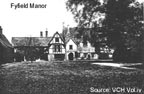 Fyfield Manor, lies to the west of the Church, and incorporates a considerable portion of a 14th century house with a great hall, porch and solar, possibly built by Sir John Golafre, who married the heiress of the Fyfields in or about 1335. The hall was divided in the reign of Elizabeth, probably when the Whites came into possession of the manor. A yew-tree walk leads through the garden to the churchyard, where formerly stood a cross erected in 1627 to William Upton.
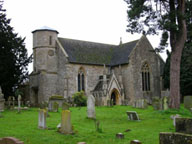
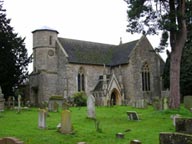
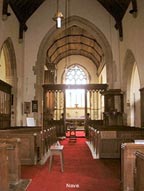
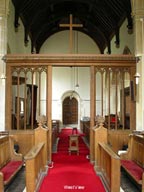
In front of the Church is the small village green where, within living memory, the stocks stood outside the Churchyard gates. The village feast was formerly kept on the Sunday after the Feast of St. Lawrence. The Church is mentioned in 1086. It was endowed with 1 carucate of land. The advowson always descended with the manor until the 16th century, but it is not mentioned in the grants to Lady Katharine Gordon or her immediate successors. It seems to have been granted to Charles Duke of Suffolk and, reverting to the Crown on his forfeiture, was granted to Sir Thomas White with the manor in 1554. From this time it resumed its descent with the manor and is now in the gift of St. John's College. The Registers, commencing in 1583, were almost entirely destroyed in a fire.
The living was a rectory until 1536, but seems to have been appropriated to St. John's College when it came into its possession, and from that time the living was a curacy, until it became a vicarage under the Act of 1867-8. The college in 1711 settled £30 per annum out of the great tithes on the vicar. Preceding priests seem to have received more from the college, and there is one story of the heir being kept out of the way while servants robbed the dying parson.
A mill is mentioned in 1427 and a hospital or almshouse was founded at Fyfield in 1442, in conjunction with a chantry at the alter of St. John Baptist in the parish Church and pursuant to the Will of Sir John Golafre, who is styled in the foundation ordinance servant to Kings Henry V and Henry VI. The chaplain was to have charge of the almshouse, and to be called the Master of the House of St. John Baptist, Fyfield. The endowments were Fyfield Grove, and the manors of Baldwin's Court and Wyke, in Charlton. The chantry-house was granted in 1548 to George Owen and others, and in February 1589-90 to William Tipper and other fishing grantees; according to tradition this house was that now known as the White Hart Inn. The White Hart Inn in Fyfield Street has the white hart painted on stucco-work on the gable.
Source Extracts: Victoria County Histories: Vol. ii p.94; Vol. iv. p.344-349St. Nicholas |
||
 St. Nicholas |
 West View |
 Nave |